Probability
Comprehensive Question Bank & Study Notes
Quick Revision Notes
Probability
1. Fundamentals of Probability (Recap and Algebra of Events)
Objective: To refresh the fundamental concepts of probability from Class 11 and establish the set-theoretic approach (Algebra of Events) required for advanced Class 12 topics.Basic Terminology (Quick Recap)
Before diving into complex theorems, we must be absolutely clear on the foundational terms.
- Random Experiment: An experiment where all possible outcomes are known, but the exact outcome cannot be predicted in advance.
- Sample Space ($S$): The complete set of all possible outcomes of a random experiment.
- Event ($E$): Any subset of the sample space. It can consist of one or more outcomes. If an outcome belongs to the subset $E$, we say the event has occurred.
- Simple Event: An event containing exactly one outcome.
- Compound Event: An event containing more than one outcome.
- Impossible Event: An event that has absolutely no chance of occurring.
- Sure Event (or Certain Event): An event that is absolutely guaranteed to happen.
- Favorable Event (or Favorable Outcome): A favorable event refers to the specific results of an experiment that satisfy the condition you are looking for.
Algebra of Events
In Class 12, we heavily rely on set theory to understand probability. Let $A$ and $B$ be two events associated with a sample space $S$.
- Event "A or B" (Union): Denoted by $A \cup B$. It means at least one of the events $A$ or $B$ occurs.
- Event "A and B" (Intersection): Denoted by $A \cap B$. It means both events $A$ and $B$ occur simultaneously.
- Event "Not A" (Complement): Denoted by $A'$ or $A^c$ or $\bar{A}$. It means event $A$ does not occur.
$$A' = S - A$$ - Event "A but not B" (Difference): Denoted by $A - B$ or $A \cap B'$. It means $A$ occurs but $B$ does not.
Crucial Types of Events
Understanding the distinction between these types of events is critical for solving complex problems later in the chapter.
- Mutually Exclusive Events (Disjoint Events): Events that cannot occur at the same time. There is no common outcome between them.
Mathematical Condition: $$A \cap B = \emptyset$$ - Exhaustive Events: A set of events that together cover the entire sample space. At least one of these events is guaranteed to occur whenever the experiment is performed.
Mathematical Condition: $$E_1 \cup E_2 \cup \dots \cup E_n = S$$ - Mutually Exclusive and Exhaustive Events: A set of events that are both disjoint and cover the whole sample space. (This concept forms the basis of the Theorem of Total Probability).
Axiomatic Approach to Probability
Let $S$ be a finite sample space and $E$ be an event. The probability function $P$ satisfies the following axioms:
- Positivity: For any event $E$, $P(E) \ge 0$.
- Certainty: The probability of the entire sample space is 1.
$$P(S) = 1$$ - Additivity: If $A$ and $B$ are mutually exclusive events, then the probability of their union is the sum of their individual probabilities.
$$P(A \cup B) = P(A) + P(B)$$
Essential Formulas for Quick Recall
- Probability of an Event: If there are $n(S)$ elementary events associated with a random experiment and $n(E)$ of them are favourable to an event $E$, then:
$$P(E) = \frac{n(E)}{n(S)}$$ - If $P(A) = 1$, then $A$ is called certain event.
- If $P(A) = 0$, then $A$ is called impossible event.
- Probability of Complementary Event: $$P(A) + P(A') = 1$$
- General Addition Theorem: $$P(A \cup B) = P(A) + P(B) - P(A \cap B)$$
- For Mutually Exclusive Events: $$P(A \cup B) = P(A) + P(B)$$
- Addition Theorem for 3 Events:
$$P(A \cup B \cup C) = P(A) + P(B) + P(C) - P(A \cap B) - P(B \cap C) - P(A \cap C) + P(A \cap B \cap C)$$
- Probability of occurrence of A only: $$P(A \cap B') = P(A) - P(A \cap B)$$
- Probability of occurrence of B only: $$P(A' \cap B) = P(B) - P(A \cap B)$$
- Probability of occurrence of exactly one of A and B:
$$P(A \cap B') + P(A' \cap B) = P(A) + P(B) - 2P(A \cap B) = P(A \cup B) - P(A \cap B)$$
2. Conditional Probability
Objective: To understand how the probability of an event changes when we have prior information that another related event has already occurred.Definition and Formula
The conditional probability of an event $A$, given that event $B$ has already occurred, is denoted by $P(A|B)$.
If $A$ and $B$ are any two events associated with the same sample space:
$$P(A|B) = \frac{P(A \cap B)}{P(B)}$$ (Provided $P(B) \neq 0$)Similarly, the probability of event $B$ occurring given that $A$ has already occurred is:
$$P(B|A) = \frac{P(A \cap B)}{P(A)}$$ (Provided $P(A) \neq 0$)Properties of Conditional Probability
- Certainty in the new space: The probability of the sample space $S$, or the given event $F$ itself, under the condition $F$ is always 1.
$$P(S|F) = P(F|F) = 1$$ - Addition Theorem for Conditional Probability: If $A$ and $B$ are any two events of $S$, and $F$ is an event such that $P(F) \neq 0$:
$$P((A \cup B)|F) = P(A|F) + P(B|F) - P((A \cap B)|F)$$ - Complementary Conditional Probability: The probability of an event not happening, given $F$, follows the standard complement rule.
$$P(E'|F) = 1 - P(E|F)$$
3. Multiplication Theorem on Probability
Objective: To calculate the probability of the simultaneous occurrence of two or more events (Intersection) using the concept of conditional probability.The Theorem
If $A$ and $B$ are two events associated with a sample space $S$, then the probability of the simultaneous occurrence of events $A$ and $B$ is the product of the probability of one event and the conditional probability of the other.
- For two events A and B:
$$P(A \cap B) = P(A) \cdot P(B|A)$$ (where $P(A) \neq 0$)
or
$$P(A \cap B) = P(B) \cdot P(A|B)$$ (where $P(B) \neq 0$) - For three events A, B, and C:
$$P(A \cap B \cap C) = P(A) \cdot P(B|A) \cdot P(C|(A \cap B))$$
Multiplication Rule for Independent Events
Two events $A$ and $B$ are said to be independent if the occurrence (or non-occurrence) of one does not affect the probability of the occurrence of the other. In this case, $P(A|B) = P(A)$ and $P(B|A) = P(B)$.
- Mathematical Condition for Independence:
$$P(A \cap B) = P(A) \cdot P(B)$$ - For n Independent Events:
$$P(E_1 \cap E_2 \cap \dots \cap E_n) = P(E_1) \cdot P(E_2) \cdot \dots \cdot P(E_n)$$
Important Points to Remember
- Difference between Mutually Exclusive and Independent Events: Mutually exclusive events cannot happen together (Intersection is zero), while Independent events can happen together, but they do not influence each other.
- If $A$ and $B$ are independent, then:
- $A'$ and $B$ are independent.
- $A$ and $B'$ are independent.
- $A'$ and $B'$ are independent.
4. Theorem of Total Probability
Objective: To find the total probability of an event that can happen through several distinct paths or scenarios.Partition of a Sample Space
A set of events $E_1, E_2, \dots, E_n$ is said to represent a partition of the sample space $S$ if they are mutually exclusive (disjoint), exhaustive, and have non-zero probabilities.
Statement of the Theorem
Let {$E_1, E_2, \dots, E_n$} be a partition of the sample space $S$. For any event $A$ associated with $S$, the total probability of $A$ is given by:
$$P(A) = P(E_1)P(A|E_1) + P(E_2)P(A|E_2) + \dots + P(E_n)P(A|E_n)$$In summation notation:
$$P(A) = \sum_{i=1}^{n} P(E_i)P(A|E_i)$$5. Bayes' Theorem
Objective: To find the "reverse" probability (posterior probability)—calculating the probability of a specific cause (scenario) given that the effect (event A) has already occurred.The Formula
If $E_1, E_2, \dots, E_n$ are $n$ mutually exclusive and exhaustive events, and $A$ is an event of non-zero probability, then the probability of occurrence of $E_i$ given $A$ is:
$$P(E_i|A) = \frac{P(E_i)P(A|E_i)}{\sum_{j=1}^{n} P(E_j)P(A|E_j)}$$Where:
- $P(E_i)$ is the Prior Probability (probability of the cause before the experiment).
- $P(A|E_i)$ is the Likelihood (probability of the event given the cause).
- $P(E_i|A)$ is the Posterior Probability (probability of the cause after the event is observed).
Key Difference in Application
- Total Probability: Used when you want to find the probability of the "result" (e.g., What is the probability that a randomly drawn bulb is defective?).
- Bayes' Theorem: Used when the result is known and you want to find the "source" (e.g., Given that the bulb is defective, what is the probability it was produced by Machine A?).
Multiple Choice Questions
AI Tutor Explanation
Powered by Gemini
AI generated content. Review strictly for academic accuracy.
AI Tutor Explanation
Powered by Gemini
AI generated content. Review strictly for academic accuracy.
AI Tutor Explanation
Powered by Gemini
AI generated content. Review strictly for academic accuracy.
AI Tutor Explanation
Powered by Gemini
AI generated content. Review strictly for academic accuracy.
AI Tutor Explanation
Powered by Gemini
AI generated content. Review strictly for academic accuracy.
AI Tutor Explanation
Powered by Gemini
AI generated content. Review strictly for academic accuracy.
AI Tutor Explanation
Powered by Gemini
AI generated content. Review strictly for academic accuracy.
AI Tutor Explanation
Powered by Gemini
AI generated content. Review strictly for academic accuracy.
AI Tutor Explanation
Powered by Gemini
AI generated content. Review strictly for academic accuracy.
AI Tutor Explanation
Powered by Gemini
AI generated content. Review strictly for academic accuracy.
AI Tutor Explanation
Powered by Gemini
AI generated content. Review strictly for academic accuracy.
AI Tutor Explanation
Powered by Gemini
AI generated content. Review strictly for academic accuracy.
AI Tutor Explanation
Powered by Gemini
AI generated content. Review strictly for academic accuracy.
AI Tutor Explanation
Powered by Gemini
AI generated content. Review strictly for academic accuracy.
AI Tutor Explanation
Powered by Gemini
AI generated content. Review strictly for academic accuracy.
Very Short Answer (2 Mark)
AI Tutor Explanation
Powered by Gemini
AI generated content. Review strictly for academic accuracy.
AI Tutor Explanation
Powered by Gemini
AI generated content. Review strictly for academic accuracy.
Short Answer (3 Marks)
AI Tutor Explanation
Powered by Gemini
AI generated content. Review strictly for academic accuracy.
AI Tutor Explanation
Powered by Gemini
AI generated content. Review strictly for academic accuracy.
AI Tutor Explanation
Powered by Gemini
AI generated content. Review strictly for academic accuracy.
AI Tutor Explanation
Powered by Gemini
AI generated content. Review strictly for academic accuracy.
AI Tutor Explanation
Powered by Gemini
AI generated content. Review strictly for academic accuracy.
AI Tutor Explanation
Powered by Gemini
AI generated content. Review strictly for academic accuracy.
AI Tutor Explanation
Powered by Gemini
AI generated content. Review strictly for academic accuracy.
AI Tutor Explanation
Powered by Gemini
AI generated content. Review strictly for academic accuracy.
AI Tutor Explanation
Powered by Gemini
AI generated content. Review strictly for academic accuracy.
AI Tutor Explanation
Powered by Gemini
AI generated content. Review strictly for academic accuracy.
AI Tutor Explanation
Powered by Gemini
AI generated content. Review strictly for academic accuracy.
AI Tutor Explanation
Powered by Gemini
AI generated content. Review strictly for academic accuracy.
AI Tutor Explanation
Powered by Gemini
AI generated content. Review strictly for academic accuracy.
AI Tutor Explanation
Powered by Gemini
AI generated content. Review strictly for academic accuracy.
AI Tutor Explanation
Powered by Gemini
AI generated content. Review strictly for academic accuracy.
AI Tutor Explanation
Powered by Gemini
AI generated content. Review strictly for academic accuracy.
AI Tutor Explanation
Powered by Gemini
AI generated content. Review strictly for academic accuracy.
AI Tutor Explanation
Powered by Gemini
AI generated content. Review strictly for academic accuracy.
$$\begin{array}{|c|c|c|c|}
\hline
X & 1 & 2 & 3 \\
\hline
P(X) & \frac{k}{2} & \frac{k}{3} & \frac{k}{6} \\
\hline
\end{array}$$
(i) Find the value of $k$.
(ii) Find $P(1\le X<3)$.
(iii) Find $E(X)$, the mean of $X$.
OR
$A$ and $B$ are independent events such that $P(A\cap\overline{B})=\frac{1}{4}$ and $P(\overline{A}\cap B)=\frac{1}{6}$ Find $P(A)$ and $P(B)$.
AI Tutor Explanation
Powered by Gemini
AI generated content. Review strictly for academic accuracy.
Long Answer (5 Marks)
AI Tutor Explanation
Powered by Gemini
AI generated content. Review strictly for academic accuracy.
Case Study & Passage Based
(i) Find the probability that it was defective.
(ii) What is the probability that this defective smartphone was manufactured by company B ?
AI Tutor Explanation
Powered by Gemini
AI generated content. Review strictly for academic accuracy.
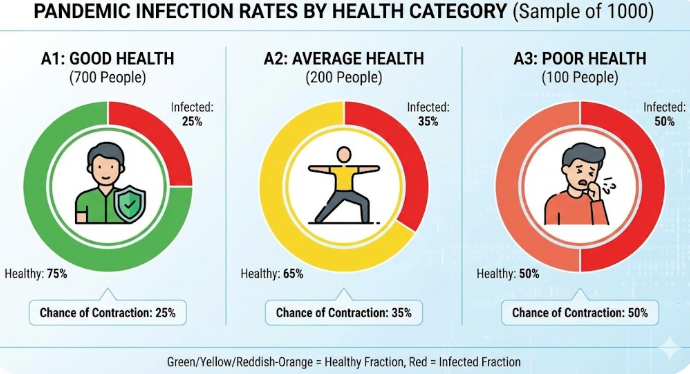 Based upon the results of regular medical check-ups in a hospital, it was found that out of 1000 people, 700 were very healthy, 200 maintained average health and 100 had a poor health record.
Let $A_1$: People with good health,
$A_2$: People with average health,
and $A_3$: People with poor health.
During a pandemic, the data expressed that the chances of people contracting the disease from category $A_1$, $A_2$ and $A_3$ are 25%, 35% and 50%, respectively.
(ii) Given that the person has not contracted the disease, what is the probability that the person is from category $A_2$ ?
AI Tutor Explanation
Powered by Gemini
AI generated content. Review strictly for academic accuracy.
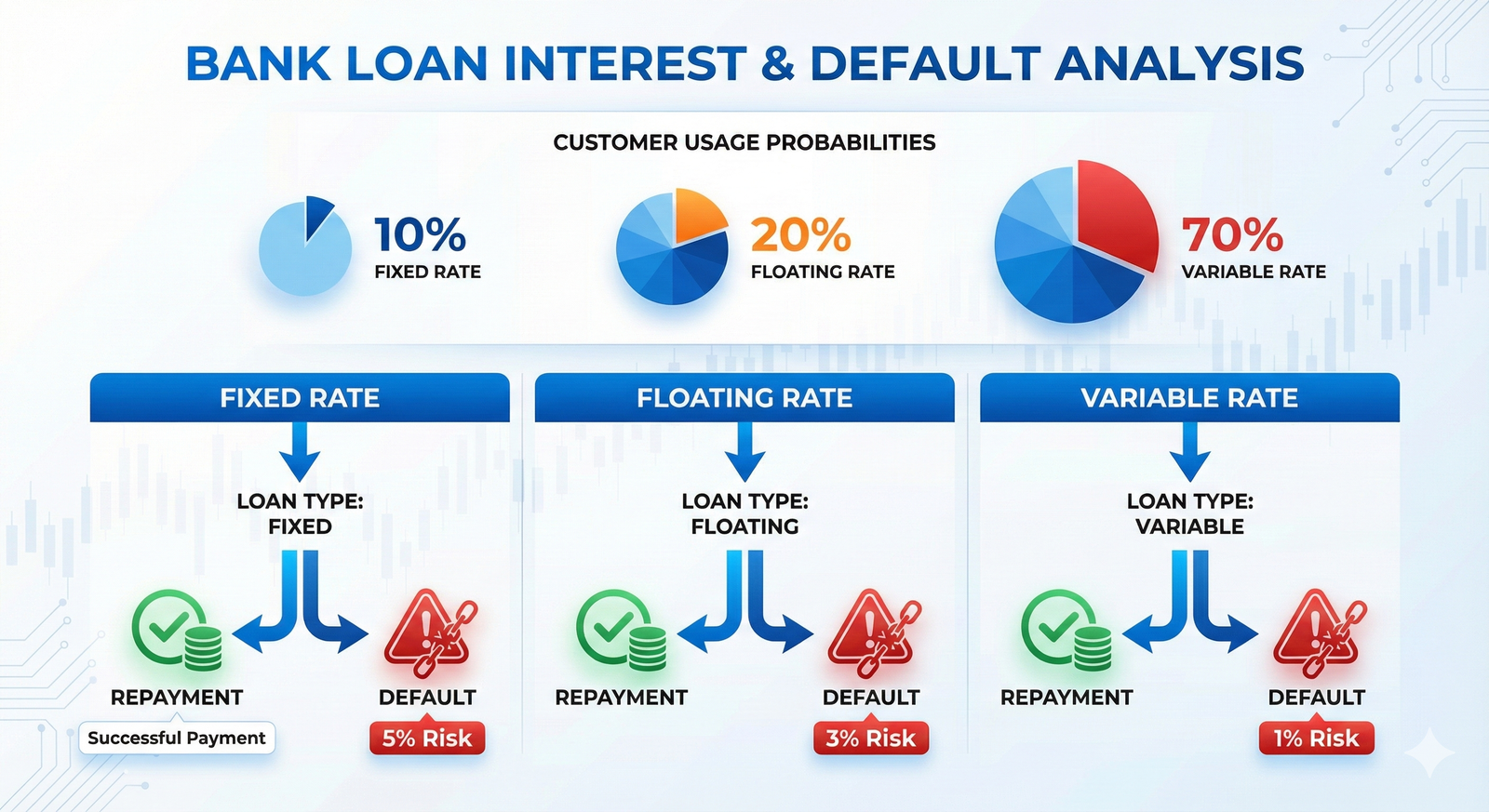 A bank offers loan to its customers on different types of interest namely, fixed rate, floating rate and variable rate. From the past data with the bank, it is known that a customer avails loan on fixed rate, floating rate or variable rate with probabilities 10%, 20% and 70% respectively. A customer after availing loan can pay the loan or default on loan repayment. The bank data suggests that the probability that a person defaults on loan after availing it at fixed rate, floating rate and variable rate is 5%, 3% and 1% respectively.
 AI Tutor Explanation
Powered by Gemini
AI generated content. Review strictly for academic accuracy.
AI Tutor Explanation
Powered by Gemini
AI generated content. Review strictly for academic accuracy.