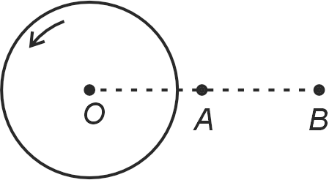
 A thin horizontal disc is rotating about a vertical axis passing through its fixed centre O. Its angular momentum is $L_{A}$ and $L_{B}$ computed about points A and B, respectively, with $OB=2\times OA.$ The value of $\frac{L_{A}}{L_{B}}$ is:
Detailed Solution
Step 1: Understanding Angular Momentum about a point
The angular momentum $L$ of a rigid body rotating about a fixed axis passing through its center of mass $O$ is given by $L = I_{cm}\omega$. When calculating angular momentum about any arbitrary point $P$ in the plane of rotation, the formula is $L_P = L_{cm} + \vec{r} \times \vec{p}$, where $\vec{p}$ is the linear momentum of the center of mass.
Step 2: Analyzing the system
Since the disc is rotating about a fixed axis passing through its center $O$, the center of mass is stationary. Therefore, the linear momentum of the center of mass is zero ($\vec{p} = 0$).
Step 3: Calculating $L_A$ and $L_B$
Because the center of mass is fixed at $O$, the angular momentum about any point in the plane is simply the angular momentum about the center of mass. Thus: $$L_A = I_{cm}\omega$$ $$L_B = I_{cm}\omega$$
Step 4: Finding the ratio
Since both $L_A$ and $L_B$ are equal to the intrinsic angular momentum of the disc about its axis of rotation, their ratio is: $$\frac{L_A}{L_B} = \frac{I_{cm}\omega}{I_{cm}\omega} = 1$$
Final Answer: 1
AI generated content. Review strictly for academic accuracy.