Available Questions 831 found Page 38 of 42
Standalone Questions
#640
Mathematics
Applications of Integrals
MCQ_SINGLE
APPLY
2025
AISSCE(Board Exam)
Competency
1 Marks
The area of the region enclosed between the curve \(y=x|x|\), x-axis, \(x=-2\) and \(x=2\) is:
(A) \(\frac{8}{3}\)
(B) \(\frac{16}{3}\)
(C) 0
(D) 8
Key:
Sol:
Sol:
The function is given by $y=x|x|$. We can define this piecewise:
$$y = \begin{cases} x^2 & \text{if } x \ge 0 \\ -x^2 & \text{if } x < 0 \end{cases}$$
The area $A$ enclosed between the curve, the x-axis, $x=-2$ and $x=2$ is given by the integral of the absolute value of the function over the interval $[-2, 2]$:
$$A = \int_{-2}^{2} |y| \, dx = \int_{-2}^{2} |x|x|| \, dx$$
Since $|x| \ge 0$, we have $|x|x|| = |x||x| = x^2$.
So, the integral becomes:
$$A = \int_{-2}^{2} x^2 \, dx$$
We can evaluate this integral:
$$A = \left[ \frac{x^3}{3} \right]_{-2}^{2} = \frac{(2)^3}{3} - \frac{(-2)^3}{3}$$
$$A = \frac{8}{3} - \frac{-8}{3} = \frac{8}{3} + \frac{8}{3} = \frac{16}{3}$$
The final answer is $\boxed{\frac{16}{3}}$.
#639
Mathematics
Applications of Integrals
MCQ_SINGLE
APPLY
2024
AISSCE(Board Exam)
KNOWLEDGE
1 Marks
Area of the region bounded by curve \(y^{2}=4x\) and the X-axis between \(x=0\) and \(x=1\) is:
(A) \(\frac{2}{3}\)
(B) \(\frac{8}{3}\)
(C) 3
(D) \(\frac{4}{3}\)
Key:
Sol:
Sol:
The region is bounded by the parabola $y^2=4x$, the X-axis ($y=0$), $x=0$, and $x=1$.
Since the parabola is symmetric about the X-axis, the total area can be found by calculating the area of the upper half (where $y = 2\sqrt{x}$) and multiplying by 2.
1. From $y^2=4x$, we get $y = \pm \sqrt{4x} = \pm 2\sqrt{x}$.
2. The area $A$ is given by the integral of $y$ with respect to $x$ from $x=0$ to $x=1$. Due to symmetry, we calculate the area for $y=2\sqrt{x}$ and multiply by 2.
$$A = 2 \int_{0}^{1} 2\sqrt{x} \, dx$$
3. Evaluate the integral:
$$A = 4 \int_{0}^{1} x^{1/2} \, dx$$
$$A = 4 \left[ \frac{x^{3/2}}{3/2} \right]_{0}^{1}$$
$$A = 4 \left[ \frac{2}{3} x^{3/2} \right]_{0}^{1}$$
4. Apply the limits of integration:
$$A = \frac{8}{3} \left( (1)^{3/2} - (0)^{3/2} \right)$$
$$A = \frac{8}{3} (1 - 0)$$
$$A = \frac{8}{3}$$
The final answer is $\boxed{\frac{8}{3}}$.
#638
Mathematics
Applications of Integrals
MCQ_SINGLE
APPLY
2025
AISSCE(Board Exam)
KNOWLEDGE
1 Marks
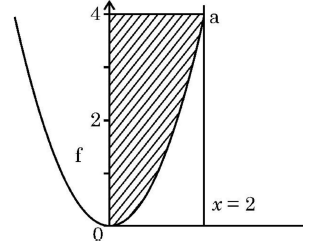
(A) \( \int_{0}^{4} x \, dx\)
(B) \( \int_{0}^{2} y^2 \, dy\)
(C) \( 2 \int_{0}^{4} \sqrt{x} \, dx\)
(D) \( \int_{0}^{4} \sqrt{x} \, dx\)
Key: D
Sol:
Sol:
The curve \( y^2 = x \) is symmetric about the x-axis.
The shaded area is the area above the x-axis:
Answer:
\( \int_0^4 \sqrt{x} \, dx \)
#637
Mathematics
Applications of Integrals
MCQ_SINGLE
APPLY
2025
AISSCE(Board Exam)
KNOWLEDGE
1 Marks
The area of the region bounded by the curve \(y^{2}=x\) between \(x=0\) and \(x=1\) is:
(A) \(\frac{3}{2}\) sq units
(B) \(\frac{2}{3}\) sq units
(C) 3 sq units
(D) \(\frac{4}{3}\) sq units
Key: B
Sol:
Sol:
**Correct Option if MCQ:** B
**Reasoning:**
* \(y = \sqrt{x}\)
* Area = \(\int_{0}^{1} \sqrt{x} dx\)
* Area = \([\frac{2}{3}x^{\frac{3}{2}}]_{0}^{1} = \frac{2}{3}\)
#636
Mathematics
Definite Integrals
MCQ_SINGLE
APPLY
2025
AISSCE(Board Exam)
KNOWLEDGE
1 Marks
If \(f(2a-x)=f(x)\), then \(\int_{0}^{2a}f(x)dx\) is
(A) \(\int_{0}^{2a}f(\frac{x}{2})dx\)
(B) \(\int_{0}^{a}f(x)dx\)
(C) \(2\int_{a}^{0}f(x)dx\)
(D) \(2\int_{0}^{a}f(x)dx\)
Key:
Sol:
Sol:
**Correct Option if MCQ:** D
**Reasoning:**
* Let \(I = \int_{0}^{2a}f(x)dx\).
* Using the property \(\int_{0}^{na}f(x)dx = n\int_{0}^{a}f(x)dx\) for \(f(x)=f(2a-x)\).
* Thus, \(I = 2\int_{0}^{a}f(x)dx\).
#635
Mathematics
Definite Integrals
MCQ_SINGLE
APPLY
2025
AISSCE(Board Exam)
KNOWLEDGE
1 Marks
The value of \(\int_{0}^{1}\frac{dx}{e^{x}+e^{-x}}\) is:
(A) \(-\frac{\pi}{4}\)
(B) \(\frac{\pi}{4}\)
(C) \(\tan^{-1}e-\frac{\pi}{4}\)
(D) \(\tan^{-1}e\)
Key: C
Sol:
Sol:
\[\frac{1}{e^{x}+e^{-x}} = \frac{1}{e^{x} + \frac{1}{e^{x}}} = \frac{1}{\frac{e^{2x} + 1}{e^x}} = \frac{e^x}{e^{2x} + 1}\]
The integral becomes:
\[I = \int_{0}^{1}\frac{e^x}{e^{2x} + 1}dx\]Now use Substitution
Let \(u = e^x\). Then, \(du = e^x dx\).
Change the limits of integration:
- Lower limit (\(x=0\)): \(u_1 = e^0 = 1\)
- Upper limit (\(x=1\)): \(u_2 = e^1 = e\)
The integral becomes:
\[I = \int_{1}^{e}\frac{du}{u^{2} + 1}\]Now evaluate and Apply Limits
\[I = \left[ \tan ^{-1}(u) \right]_{1}^{e}\] \[=\tan ^{-1}(e) - \frac{\pi}{4}\]
#634
Mathematics
Definite Integrals
MCQ_SINGLE
APPLY
2025
AISSCE(Board Exam)
KNOWLEDGE
1 Marks
\(\int_{0}^{\pi/2}\cos x\cdot e^{\sin x}dx\) is equal to:
(A) 0
(B) \(1-e\)
(C) \(e-1\)
(D) e
Key:
Sol:
Sol:
#633
Mathematics
Definite Integrals
MCQ_SINGLE
UNDERSTAND
2024
AISSCE(Board Exam)
KNOWLEDGE
1 Marks
\(\int_{a}^{b}f(x)dx\) is equal to:
(A) \(\int_{a}^{b}f(a-x)dx\)
(B) \(\int_{a}^{b}f(a+b-x)dx\)
(C) \(\int_{a}^{b}f(x-(a+b))dx\)
(D) \(\int_{a}^{b}f((a-x)+(b-x))dx\)
Key:
Sol:
Sol:
#632
Mathematics
Definite Integrals
MCQ_SINGLE
APPLY
2024
AISSCE(Board Exam)
KNOWLEDGE
1 Marks
\(\int_{0}^{\pi/2}\frac{\sin~x-\cos~x}{1+\sin~x~\cos~x}dx\) is equal to:
(A) \(\pi\)
(B) Zero (0)
(C) \(\int_{0}^{\pi/2}\frac{2~\sin~x}{1+\sin~x~\cos~x}dx\)
(D) \(\frac{\pi^{2}}{4}\)
Key: B
Sol:
Sol:
#631
Mathematics
Definite Integrals
MCQ_SINGLE
UNDERSTAND
2024
AISSCE(Board Exam)
KNOWLEDGE
1 Marks
\(\int_{-a}^{a}f(x)dx=0,\) if :
(A) \(f(-x)=f(x)\)
(B) \(f(-x)=-f(x)\)
(C) \(f(a-x)=f(x)\)
(D) \(f(a-x)=-f(x)\)
Key:
Sol:
Sol:
#630
Mathematics
Definite Integrals
MCQ_SINGLE
UNDERSTAND
2024
AISSCE(Board Exam)
KNOWLEDGE
1 Marks
The value of \(\int_{0}^{3}\frac{dx}{\sqrt{9-x^{2}}}\) is:
(A) \(\frac{\pi}{6}\)
(B) \(\frac{\pi}{4}\)
(C) \(\frac{\pi}{2}\)
(D) \(\frac{\pi}{18}\)
Key:
Sol:
Sol:
#629
Mathematics
Definite Integrals
MCQ_SINGLE
APPLY
2024
AISSCE(Board Exam)
KNOWLEDGE
1 Marks
The value of \(\int_{-1}^{1}x|x|dx\) is:
(A) \(\frac{1}{6}\)
(B) \(\frac{1}{3}\)
(C) \(-\frac{1}{6}\)
(D) 0
Key:
Sol:
Sol:
#628
Mathematics
Integrals
MCQ_SINGLE
APPLY
2025
AISSCE(Board Exam)
KNOWLEDGE
1 Marks
\(\int_{-1}^{1} \frac{|x|}{x} \, dx, x \ne 0 \text{ is equal to}\)
(A) \(-1\)
(B) 0
(C) 1
(D) 2
Key: B
Sol:
Sol:
#627
Mathematics
Integrals
MCQ_SINGLE
APPLY
2025
AISSCE(Board Exam)
KNOWLEDGE
1 Marks
If
\(
\int \frac{2^\frac{1}{x}}{x^2} dx = k \cdot 2^{\frac{1}{x}} + C,
\)
then \(k\) is equal to
\(
\int \frac{2^\frac{1}{x}}{x^2} dx = k \cdot 2^{\frac{1}{x}} + C,
\)
then \(k\) is equal to
(A) \(\dfrac{-1}{\log 2}\)
(B) \(-\log 2\)
(C) -1
(D) \(\dfrac{1}{2}\)
Key: A
Sol:
Sol:
Let \(u = \frac{1}{x} = x^{-1}\)
Differentiating \(u\) with respect to \(x\) : \( du = -\frac{1}{x^2} dx\)
Substitute \(u\) and \(du\) into the integral:
\(\displaystyle \int \frac{1}{x^2} 2^{\frac{1}{x}} dx = \int 2^u (-du) = - \int 2^u du\)
Using the standard integral formula \(\displaystyle \int a^u du = \frac{a^u}{\ln a} + C\) (with \(a=2\)):
\(\displaystyle - \int 2^u du = - \left( \frac{2^u}{\ln 2} \right) + C\)
Hence
\(\displaystyle \int \frac{1}{x^2} 2^{\frac{1}{x}} dx = - \frac{1}{\ln 2} \cdot 2^{\frac{1}{x}} + C\)
Determining the Value of \(k\)
By comparing our result with the given form \(\displaystyle k \cdot 2^{\frac{1}{x}} + C\):
\(\displaystyle k \cdot 2^{\frac{1}{x}} + C = - \frac{1}{\ln 2} \cdot 2^{\frac{1}{x}} + C\)
The value of \(k\) is:
\(\displaystyle k = - \frac{1}{\ln 2}\)
Since \(\log 2\) in the options typically denotes the natural logarithm \(\ln 2\) in calculus, the answer is:
\(\displaystyle \frac{-1}{\log 2}\)